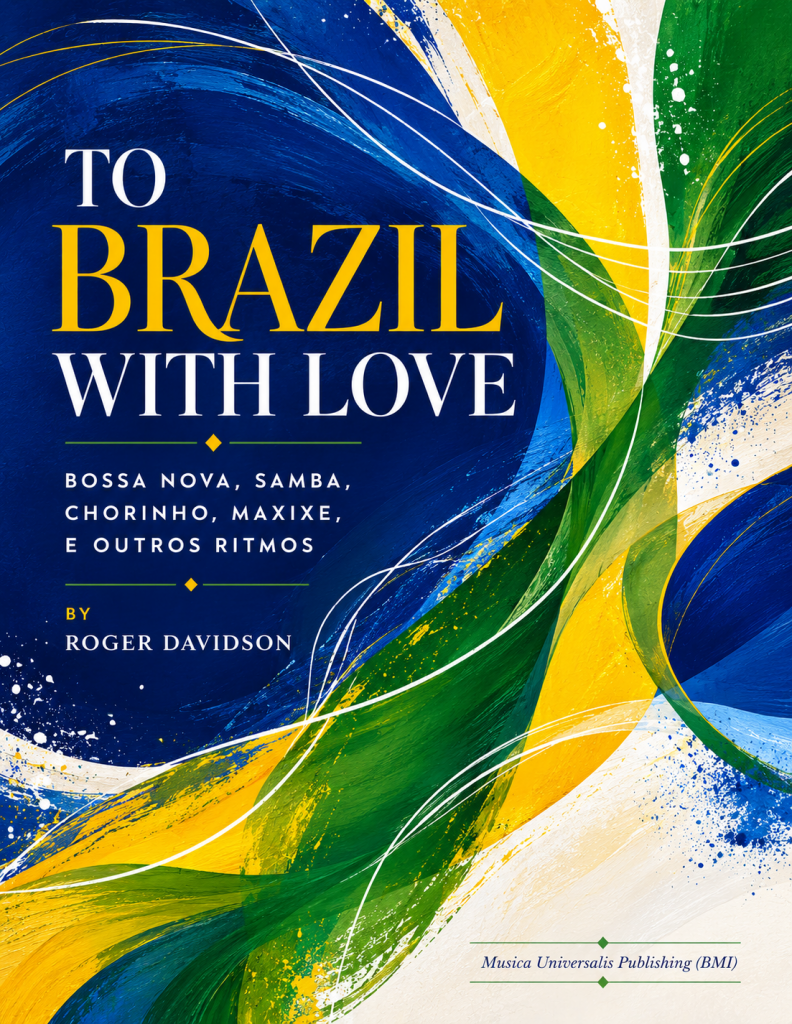
The vibrant body of music in this volume was created by a French–born, American composer with a burning passion for Brazil. While Roger Davidson may be best–known for his classical works, his empathy with other cultures has led him to explore musical languages of many origins. Along the way he has written perhaps the largest catalog of Brazilian–style songs ever penned by a foreigner.
Whatever he composes, the core of Roger’s music is a melodicism that can speak to anyone. Tunefulness runs through this volume of songs, be they bossa nova, samba, chorinho, maxixe, or any of the other Brazilian styles Roger has embraced. Bossa nova’s foremost composer, Antonio Carlos Jobim (known by his nickname of Tom Jobim), has long inspired him; in fact, Jobim’s and Roger’s journeys hold several points in common. Both men’s main instrument is piano; both were influenced by the lush harmonic sophistication of Debussy and Ravel. Jazz figured prominently in Jobim’s history, as it has in Roger’s. The two composers are highly educated musicians whose work is full of international flavors.
Roger’s songbook comprises work that spans more than 45 years. It documents a love affair that began long before he had ever set foot in Brazil. Roger was still a child in 1963 when he heard Big Band Bossa Nova, saxophonist Stan Getz’s collaboration with composer/arranger Gary McFarland, followed by Getz/Gilberto, the album that had fueled the bossa nova craze in America. Getz’s partnership with João Gilberto, bossa’s stylistic pioneer, changed Roger’s life. Getz/Gilberto helped awaken him to the concept of how people of different nationalities can find shared ground through music.
His first album of Brazilian–themed compositions, Bom Dia (2008), inspired a reviewer on allmusic.com to write: “If you enjoy Brazilian music played with passion, skill, and literacy, you’ve come to the right place.” A subsequent album,
Brazilian Love Song, expanded upon all he had achieved in Bom Dia. The name of the album comes from Roger’s first bossa nova, written in 1978 and included in this songbook.
In 2011, Roger made his first trip to Rio to record a Brazilian album on native soil. His excitement began even before the plane had landed at Rio de Janeiro’s Galeão–Tom Jobim International Airport. “I felt I was coming home,” he says. “I thought, this will be another home for me someday.” Instantly he launched a relationship with the city by
giving local performances and meeting top Brazilian musicians as bossa nova pioneers Roberto Menescal and Carlos Lyra (Lyra invited Roger to his home in Ipanema), composer–singer and second–wave bossa novista Marcos Valle, and the veteran harmonica player Maurício Einhorn. An American–born, Rio–based jazz pianist, Cliff Korman, contracted the band for Roger’s album, a double CD entitled Journey to Rio. The website Critical Jazz called it “impeccable … a remarkable display of texture, color, and vibrant nuances that characterize the sound of Rio.” Roger returned to Brazil twice to play. He has released two more Brazilian albums (Oração para Amanhã and Music from the Heart) and written countless new compositions.
One of the strengths of Roger’s songwriting is his flair for evoking the literal—a scene, an object, the weather, a face–without benefit of words. While a few of the songs in this book have lyrics, Roger’s composing tells its own stories. You’ll hear this in his songs about nature, animals, even food. “Ritmo das Flores” (Rhythm of the Flowers) uses the beat of maxixe–a Brazilian relative of the tango–to evoke flowers swaying in the breeze. Dipping into chorinho, an upbeat, improvised music born in 19th–century Rio, Roger wrote “Capivara“, which darts and scampers like the Brazilian creature it was named for, the largest rodent in the world. “Os Gansos” (“The Geese“) evokes the graceful but jaunty rhythm of the animals in the title. In the playful “Cowboy Samba,” Roger manages to fuse the music of the American West with the national dance of Brazil. “Train Samba” has a locomotive–like disco beat.
As a composer devoted to building bridges between cultures, Roger enjoys cross- pollinating the music of Brazil with that of other countries, notably France, a place where bossa nova, samba, and samba–funk are revered. Drawing upon his native knowledge of French music, Roger demonstrates–in songs as varied as “Meia Noite em Paris” (Midnight in Paris), “Pour Toi Je Chante” (For You I Sing), “Quand l’Amour Viendra–t–il?” (When Will Love Come?), “Je m’en Souviens” (I Remember It), and “Soir Brésilien” (Brazilian Evening)-how congenially Brazil and France can align. The same is true of Roger’s “Churrasco Rag,” which merges chorinho.and ragtime. He unites samba with jazz and classical touches in the percussive “Cinco por Tres” (Five by Three) -thus named, he says, because “most of the harmonic language is fifths and thirds.”
Roger dedicates the wistful bossa nova “Tarde Sonhadora” (Dreamy Afternoon) to Roberto Menescal. “I thought it somehow resonated with Roberto,” he says. “Samba Legal” (Cool Samba) serves as a tribute to Gilberto Gil, the
legendary songwriter and singer from Bahia; its groovy vibe reminded him of Gil. Such dedications are nothing new for him. Roger’s friend Richard Stoltzman, the celebrated classical clarinetist, has performed and recorded Roger’s “Meditation and Dance for Clarinet and Orchestra.” In 2008, Stoltzman told Roger that his marriage was
ending. “I felt very sympathetic and I wrote a tune called ‘Letting Her Go‘ and gave him that as a gift.” The soothing quality of bossa nova proved just right in that song, as it did in “Memories of Deborah,” which Roger wrote to comfort a friend whose wife had died. Then there are the songs he wrote to get himself through his own rough times, including the dissolution of his first marriage. “Sentindo Sozinho” (Feeling Alone) and “When Will the Sun Shine Again?” have a Brazilian feeling–specifically the melancholy ache known in Portuguese as saudade, a longing for something indefinable. The songs foretold what was to come. “They were essentially prayers for love–and then I found Nilcelia, who fulfilled my dreams.” Roger’s wife since 2014, she hails from Brasília, the capital of Brazil. Nilcelia inspired many of the songs in this book, including “Valentine’s Waltz,” with its romantic, Chopin–like feeling. The chorinho “Jabuticaba” is a cheerful portrait of a blueberry–like Brazilian fruit; he had found it growing on a tree at his mother–in–law’s home in Brazil.
Nilcelia has deepened the Braziliance of Roger’s work by providing lyrics for a number of his songs, such as “Saudade do Brasil.” That ballad, he says, is “very important to us. It was written in 2015 when both of us were missing Brazil. I understood those feelings really well. When Nilcelia’s daughter Beatriz, whom Roger adopted, heard it, she said, “I thought that was a Brazilian standard!” He responded: “No, it’s a song your parents just wrote.‘
99
On occasion, Roger writes the words himself. He was moved to write an anthemic lyric called “Our Future World” and to set it to bossa–flavored music. It reflects his concern for global harmony. “In our future we’ll be one, all humanity as one/Light over darkness will have won, and peace will reign forever.” He conveys the same spirit instrumentally in the softly intense “Prayer for the World,” which he recorded on Brazilian Love Song. Once more, Brazil was very much on his mind as he wrote it. At the session, drummer Paulo Braga, who has supplied the heartbeat for some of Brazil’s greatest music, told him: “That’s a real bossa nova.”
-James Gavin, New York City, 2025
James Gavin is an award–winning music journalist whose books include Deep in a Dream: The Long Night of Chet Baker and Is That All There Is?: The Strange Life of Peggy Lee.